Inside the Pennsylvania State House, the air is heavy and stagnant. The open windows do little to alleviate the morning heat. Instead, the breeze carries the stench of the Delaware River a few blocks away. Wagon wheels creak by on the cobblestones. Voices chatter, vendors hawk their wares. The world outside is oblivious to what is happening in front of you. While they go about their lives, you are seeing your life flash before your eyes. Is the risk worth the cost?
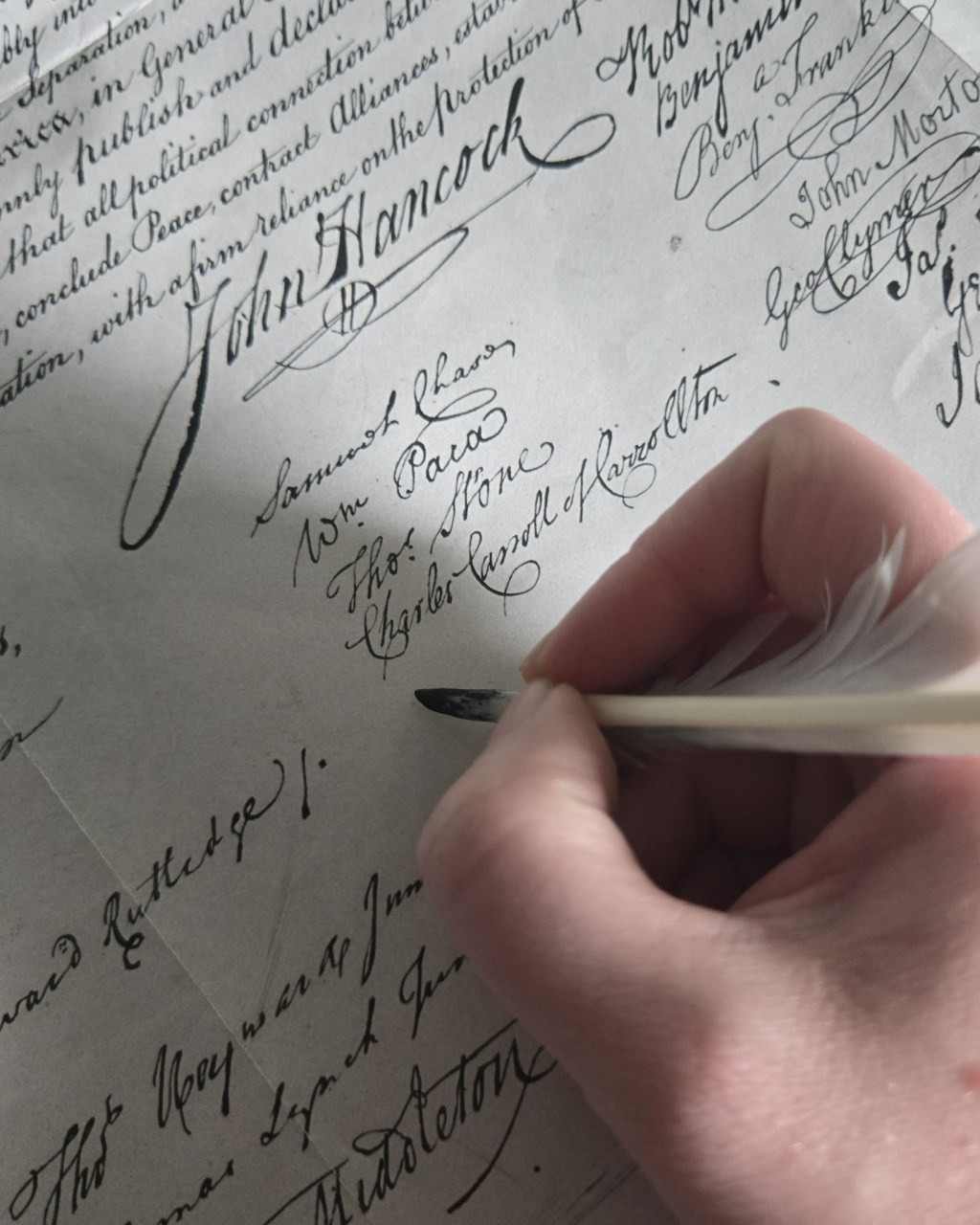
John Hancock, dressed in his best as always, takes the quill pen and dips it in the inkwell. Silence blankets the room like a shroud. All that is heard is the scratching of pen on parchment. A fly buzzes against the window next to you. Trapped.
“There,” Mr. Hancock says, returning the quill to the inkwell. “King George can read my name without spectacles and may now double his reward of £500 for my head!”
A few of your fellow delegates chuckle at his gallows humor. But the wry smile on Mr. Hancock’s face quickly fades. “We must be unanimous. There must be no pulling different ways; we must all hang together.”
Dr. Benjamin Franklin thumps his cane on the floor. “Yes, we must indeed all hang together, or most assuredly we shall all hang separately!”
The laughter that follows is a release of pent-up nerves. Yes, King George will hang you all should this revolution fail. You have been defying the empire, the nation that has been a parent to you and the rest of the little colonies that huddle along the sea. For years, you have put up with injustice, unwarranted persecution, and crippling financial burdens. You tried and tried to reason with the king and parliament. The result was even more tyranny. Last year, the Rubicon was crossed. Simmering defiance turned into musket balls. The Olive Branch petition you sent to the king, begging for an opportunity to resolve your differences was rejected. There is no hope of reconciliation, no way to appease England. Independence is the only option.
But declaring independence sets the world tilting on the verge of catastrophe. The streets of Philadelphia may be quiet, but you have just received word from New York. British troops have begun to land on Staten Island. General Washington is frantically preparing for the British invasion of the city. If they attack in force, which you know they will, there is no hope for the fledgling Continental army; they’ll have to retreat. But even then, the Redcoats might not have to launch a full operation. Reports have come in of a failed assassination attempt on General Washington. Tory spies are everywhere. Sooner or later, they might succeed and you’ll lose the commander in chief of your army. And if the British have a price on the head of the general in the field, you know they’ll have a price on the heads of every man that sent him there.
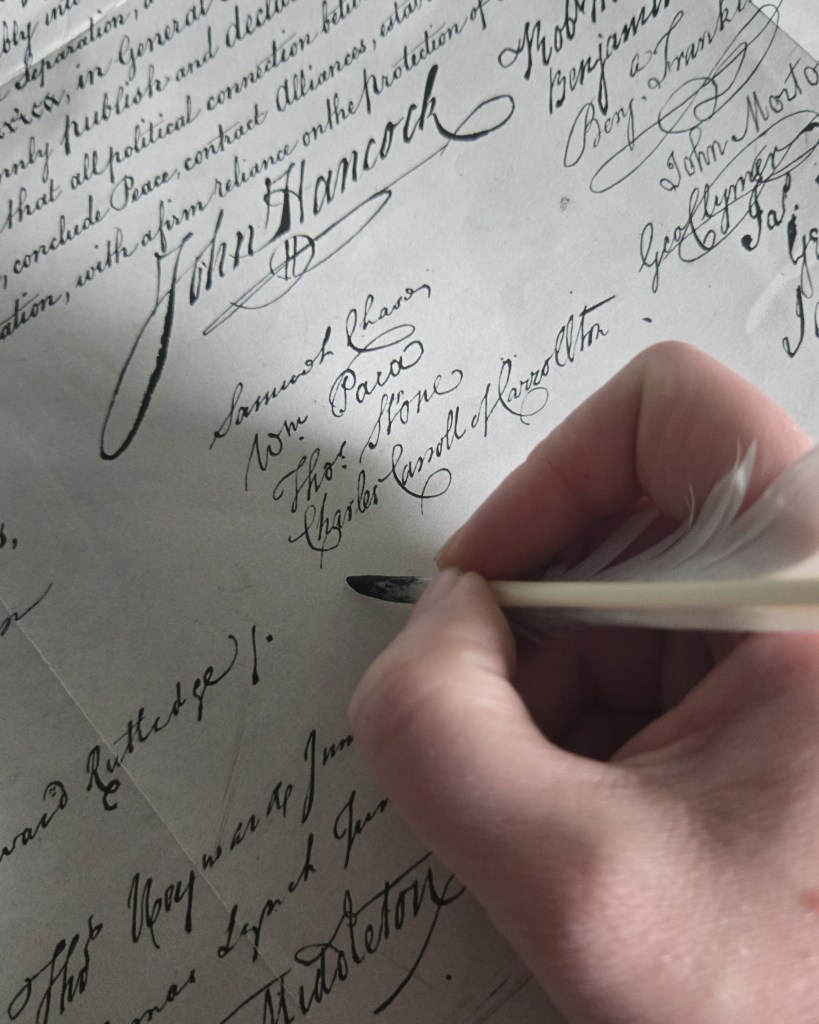
And yet, signatures continue to be scratched out.
Thomas Jefferson leans over the document he wrote, quill in hand. Two months ago, when a committee was formed to write the Declaration of Independence, Mr. Jefferson had been chosen to create the draft. He had been joined by Dr. Franklin, Mr. Adams of Massachusetts, Mr. Sherman of Connecticut, and Mr. Livingstone of New York. Lawyers, scholars, voices from all over the colonies. You’ve been learning to hang together quite well, despite your different backgrounds. Maybe the silver lining of King George’s oppression is that you’ve learned loyalty to each other. Massachusetts and Georgia don’t have much in common, but you do have the same passion for liberty and justice, and now you risk the same fate for daring to dream of such freedom.
Josiah Bartlett, a doctor from New Hampshire walks up to the table and signs his name. You’ve gotten to know him on the various committees over the past year. He has a keen mind, is diligent, and self-taught. He’s counted the cost already. Tories burned his home two years ago. Last year, the crown revoked all of his titles and commissions. Yet, he is an ardent patriot. When independence was voted on last month, he was the first to announce his “aye”.
Abraham Clark of New Jersey signs his name. He’s another patriot firebrand, a man who has no patience for royal rule and elitism. He was a poor man’s lawyer back home, doing pro bono work for those who couldn’t afford his services. Before coming to Philadelphia, he was a sheriff, trying to enforce local laws while England tied his hands by interfering with the justice system. Even if he hadn’t been a delegate, he would have signed his name to a broadside of the declaration.
Mr. Clark turns and hands the pen to the man next to him, the delegate from Pennsylvania, Mr. Morris. You hold your breath, watching, waiting. Mr. Morris holds the pen in his hand, rolling it between his fingers. He makes no move towards the paper. Instead, he reaches in his pocket for a linen handkerchief. Shoulders shaking, he breaks the stillness with his wheezing asthmatic cough. He sets down the pen and takes a sip of water. Clearing his throat, he picks up the pen again and stares at the paper. Robert Morris is wealthier than John Hancock, possibly even the richest man in the colonies. If he signs this, he may well become the poorest man in the colonies. He has tried so hard to reconcile with England, to avoid the inevitable bloodshed and destruction. He refused to vote for independence on July 4th and would have resigned from congress, but Pennsylvania sent him back.
He coughs once more. Then he signs his name.
Mr. Paca, the gentleman from Maryland signs his name. A widower with two small children. What will become of them when the British unleash their vengeance?
Mr. Carroll is recently arrived to Philadelphia. He wasn’t there to cast his vote for independence, but he eagerly signs his name today, adding his place of residence to his signature so there is no mistaking his identity. He has long fought against England’s religious persecution. Because of his Catholic faith, the government has barred him from holding office. If independence succeeds, he’ll have a chance to change that.
Mr. Hopkinson, married only two years. He is always humming a ditty, composing music, or writing witty parodies. He has a knack for creativity. Will his genius be snuffed out by the cold fury of Great Britain? Yet he signs his name.
Colonel Harrison of Virginia is a loud, boisterous man. He towers over the table, boldly scratching out his name. He passes the pen to Mr. Gerry. The Massachusetts man is half his size, skinny as a split rail. Colonel Harrison pauses, then speaks, his voice breaking the pall. “I shall have a great advantage over you, Mr. Gerry, when we are all hung for what we are now doing. From the size and weight of my body I shall die in a few minutes, but from the lightness of your body you will dance in the air an hour or two before you are dead.”
There are a few snorts of amusement from the delegates, you are all used to Colonel Harrison’s rough humor. Mr. Gerry gives a thin-lipped smile in acknowledgment, then dips the quill in ink. He signs his name.
Thomas Heyward of South Carolina has defied his father to be here. He signs his name.
Edward Rutledge is only twenty-six. He has his whole life ahead of him. In June, he had been against independence. In July, he convinced his colleagues to vote in favor of it. He takes the quill and signs his name.
Stephen Hopkins weakly shuffles to the front of the room, his body trembling with age and palsy. He has to have a secretary do all of his writing because his hands shake so badly. Yet his mind is still as sharp as ever. Self taught, he can hold his own with the most brilliant lawyer. Young Rutledge turns to the older man, dipping his head in deference as he discreetly offers to sign for him. But Mr. Hopkins pulls himself to his full height and takes the pen. The quill quivers, but his words are iron. “My hand trembles but my heart does not.” It takes him a moment to write his name. He smiles as he slowly returns to his seat.
Caesar Rodney of Delaware has never let his poor health hold him back from doing what was right. He rode through the night in a terrible storm to break Delaware’s deadlock in the vote for independence last month. He signs without hesitation.
You’ve lost count of how many men have signed so far, but soon it will be your turn. Will you sign your own death warrant?
If Britain succeeds, they will punish the colonies harshly. Martial law will be instated. Commerce will be choked off. Mass executions will snuff out the lives of everyone in this room, of everyone remotely connected to the cause. You could take your family and escape to the frontier, live a life on the run. But there will be a price on your head. Already, British envoys are working to turn the Indians against the patriots. You will be hunted down. No, the best you can hope for is prison in England.
But if America succeeds, you will have the chance to bring about a new nation. A city on a hill that shines the light of liberty to the world. The government will be run by the people, not a cold and distant monarch. Churches will thrive, people will be able to speak their minds without censure, businesses won’t be tied to the whims of a tyrant. Justice and mercy will become realities. Freedom will no longer be just a word. America will be a land of opportunity.
Dr. Franklin, old and respected by all, walks up to the dais and takes the quill. He lived abroad for years, looking out for the colonies’ interests. He had been adored by the British, but even he could see the writing on the wall with the way they snuffed out dissidents and enslaved the population by their arrogance. He had tried to warn the colonies about what was coming. Some scoffed, but he was right. He signs his name and then turns towards you, holding out the quill.
You take a step forward, reaching for the quill. It’s just a feather. It’s just ink. Just a piece of paper.
The Declaration of Independence lies on the table in front of you. Words on parchment, but so much more. An idea, a dangerous dream, a daring reality, that all men are created equal and that they are endowed by their Creator with certain inalienable rights, that among these are life, liberty, and the pursuit of happiness.
Names stretch out under your accusations against the king. Names of the men in this room representing three million colonists – no, Americans. People willing to fight, to live, and to die with a firm reliance on Divine Providence for independence. It’s never succeeded before, but maybe this time, it will.
If you sign, you are pledging your life, your fortune, and your sacred honor – all for a dream. A dream that might become reality.
Will you sign your name?

 Lakeisha Heeringa
Leave a comment